Egypt and the Politics of U.s. Economic Aid by Marvin Weinbaum
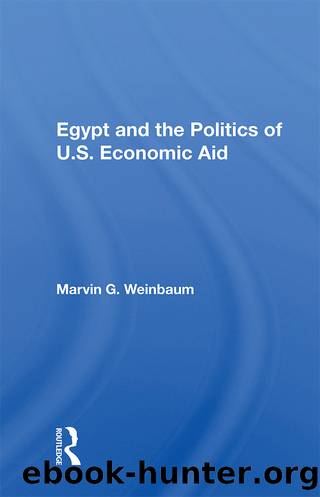
Author:Marvin Weinbaum [Weinbaum, Marvin]
Language: eng
Format: epub
Tags: History, General, Middle East
ISBN: 9780813371245
Google: GPKjAAAAIAAJ
Goodreads: 4626311
Publisher: Westview Press
Published: 1986-06-05T00:00:00+00:00
Alternative Modes
A continuing debate goes on within the U.S. aid community in Cairo and Washington about whether there are better programming approaches for assisting Egypt. These discussions involving delivery modes underscore differences of opinion on the desirable size and visibility of the programs as well as the degree of control the United States should exercise. The arguments intersect with the dialogue in progress with Egyptian officials on the best ways to achieve mutually agreed development goals and plans for domestic policy changes. The discussions reflect dissatisfactions on both sides with the prevailing approaches and pressures for some modifications, if not more radical changes. Much of the debate questions whether AID in Egypt should move away from its primary project orientation in favor of more cash transfers, sector grants, and commodity transfers, and what combination of modes is both optimal for development and politically feasible.
Cash transfers refer to the simple transfer from the United States to Egypt of dollars with which the Cairo government would presumably be free to spend as it wished.40 Examples of cash transfers are not uncommon in the U.S. global aid program, usually for specific reasons and short periods. Israel is of course the most conspicuous recipient, on a seemingly permanent basis; but Turkey in 1980 and El Salvador more recently have received cash transfers, in the first case to reward Ankara for signing an agreement with the International Monetary Fund, and in the latter for balance-of-payments support. In FY 1984, Egypt received for the first time a cash transfer of $102 million, which was repeated in FY 1985 at $100 million, and later supplemented with an emergency economic grant.
High Egyptian officials leave no doubt that they favor this mode and would like to see more project support converted to cash transfers. Some U.S. planners also find advantages in this approach. Cash transfers would no doubt reduce the administrative burden in aiding Egypt. With decisions on how to employ more of the funds left to the Egyptians, very little AID staff would be required in the country. Advocates also insist that with the Cairo government freed of most U.S. aid restrictions, the United States would become less a target of the regime's opponents and avoid being held accountable for popularly perceived development failures. In the improved political climate, AID might be better able to capture the attention of government leaders for macroeconomic reforms and to sustain Egypt's political/military cooperation with the United States. The critics of increased cash transfers stress the near impossibility of monitoring how aid dollars are used. It would be difficult, if not impossible, to ensure that the aid went to priority areas or, in fact, was devoted to development purposes. These critics are convinced that without AID and other foreign donors, most notably the World Bank, the Egyptians would be under no pressure to think systematically about their development program.
Sector grants represent something of a compromise between the familiar project approach and cash transfers. These general grants to the recipient designate that projects be located or funds otherwise used in particular sectors or subsectors of the economy.
Download
This site does not store any files on its server. We only index and link to content provided by other sites. Please contact the content providers to delete copyright contents if any and email us, we'll remove relevant links or contents immediately.
| Anthropology | Archaeology |
| Philosophy | Politics & Government |
| Social Sciences | Sociology |
| Women's Studies |
The Secret History by Donna Tartt(19096)
The Social Justice Warrior Handbook by Lisa De Pasquale(12191)
Thirteen Reasons Why by Jay Asher(8914)
This Is How You Lose Her by Junot Diaz(6890)
Weapons of Math Destruction by Cathy O'Neil(6282)
Zero to One by Peter Thiel(5804)
Beartown by Fredrik Backman(5759)
The Myth of the Strong Leader by Archie Brown(5510)
The Fire Next Time by James Baldwin(5450)
How Democracies Die by Steven Levitsky & Daniel Ziblatt(5221)
Promise Me, Dad by Joe Biden(5154)
Stone's Rules by Roger Stone(5088)
A Higher Loyalty: Truth, Lies, and Leadership by James Comey(4965)
100 Deadly Skills by Clint Emerson(4927)
Rise and Kill First by Ronen Bergman(4790)
Secrecy World by Jake Bernstein(4754)
The David Icke Guide to the Global Conspiracy (and how to end it) by David Icke(4720)
The Farm by Tom Rob Smith(4514)
The Doomsday Machine by Daniel Ellsberg(4491)
